Saturday, 29 July 2023

Building a Solid Foundation: The Unbreakable Bond Between Site Engineers and Geotechnical Engineers


In the ever-evolving world of construction, where structures reach for the sky, a strong foundation becomes the anchor of every project. The dynamic collaboration between site engineers and geotechnical engineers forms the bedrock of successful construction endeavors. Like a beautifully orchestrated symphony, their partnership ensures that the soil beneath our feet is thoroughly understood, respected, and transformed into a secure and stable base for architectural marvels. In this captivating blog, we embark on a journey into the captivating realm of the unique bond between site engineers and geotechnical engineers, illuminating the vital role they play in crafting structures that withstand the test of time.


The Significance of Geotechnical Insights:

As the site engineer orchestrates the construction process on the ground, they rely on the profound expertise of geotechnical engineers to comprehend the underlying soil conditions. From the intricate analysis of soil stability to the meticulous determination of bearing capacity, the geotechnical engineer's insights inform pivotal decisions that profoundly impact foundation design, earthwork, and slope stability. The site engineer's keen grasp of these geotechnical reports ensures that construction activities are expertly tailored to the soil's distinct characteristics.


Embarking on Pre-Construction Site Investigations:

The harmonious partnership commences with pre-construction site investigations. Engaging in a captivating dance, the geotechnical engineer embarks on a quest of in-depth soil exploration, collecting samples and conducting tests to unveil the soil's enigmatic properties. Hand in hand, the site engineer provides valuable input on the project's unique requirements, as together, they weave an intricate tapestry of understanding, unravelling the geotechnical secrets that pave the way for a robust and efficient construction plan.


Designing Robust Foundations:

Armed with invaluable geotechnical data, the site engineer and the geotechnical engineer blend their expertise to design foundations of unmatched strength. With a harmonious rhythm, the site engineer weaves the construction plan around the geotechnical recommendations, artfully balancing structural requirements and soil properties. The symbiosis of their proficiency ensures that the foundation design harmonizes perfectly with the site's unique geotechnical challenges, thwarting potential construction woes and guaranteeing resolute stability for the future.


Navigating Site Challenges with Finesse:

Every construction site presents its own mystifying challenges, with soil conditions as diverse as the colors of the rainbow. The site engineer and the geotechnical engineer, akin to intrepid explorers, unite to unravel potential risks and artfully implement tailored solutions. From soil stabilization enchantments to earthwork transformations and majestic retaining wall designs, their seamless cooperation empowers them to dance gracefully with the site's unforeseen hurdles, resolving them with artistic flair.


Real-Time Adaptations: A Synchronized Symphony:

Construction, like a symphony, is dynamic, where surprises may lay in wait beneath the surface. As the project dances forward, unforeseen geotechnical challenges may emerge, calling for nimble adaptations. The seamless coordination between site engineers and geotechnical engineers, akin to a synchronized symphony, enables swift adjustments. With a harmonious melody of communication and shared expertise, they confidently confront unexpected hurdles while staying true to the project's visionary symphony.


Safety and Compliance as the Crescendo:

Safety stands as the crescendo of any structure's melody. With unwavering precision, the site engineer, alongside the steadfast support of the geotechnical engineer, ensures that all safety standards and regulations are meticulously adhered to. They weave their magic in unison, crafting measures that safeguard against soil-related hazards, fostering the well-being of workers and future occupants alike.


Conclusion:


The unbreakable bond shared between site engineers and geotechnical engineers becomes the invisible hand that guides every construction project to soaring heights. With their minds entwined, their expertise intertwined, and their hearts beating in harmony, they lay the groundwork for architectural wonders that will stand tall and proud for generations to come. So, let us celebrate the magnificent symphony of partnership that builds a stronger, safer, and more enchanting tomorrow! 🏗️💪


Wednesday, 26 July 2023

A Guide for Fresh Geotechnical Interns: How to Write a Geotechnical Report


Introduction:

As a fresh geotechnical intern, writing your first geotechnical report can be a daunting task. A well-written geotechnical report is crucial for any construction project, as it provides essential information about soil conditions, foundation design, and potential risks. In this blog, we will provide a step-by-step guide to help you navigate the process of writing a geotechnical report with confidence and accuracy.


·       Understanding the Project Scope:

Begin by familiarizing yourself with the project's scope and objectives. Discuss the project requirements with your mentor or supervisor to gain clarity on what needs to be included in the report. Understand the type of structure to be built, the site location, and any specific concerns related to the soil conditions.

When you start working on a geotechnical report as a fresh geotechnical intern, the first step is to get a clear understanding of the project's scope and objectives. This means knowing what the project aims to achieve and what role the geotechnical report will play in the overall construction process. To do this effectively, follow these simple steps:


1.    Gather Project Information: Collect all the relevant information about the project. Understand the type of structure that is planned to be built, such as a building, bridge, or road. Note the site location, as soil conditions can vary depending on the geographic area.


2.    Discuss with Your Mentor or Supervisor: Reach out to your mentor or supervisor, who will be experienced in geotechnical engineering. Have a conversation to discuss the project requirements and the specific information that should be included in the report. They will guide you and provide valuable insights based on their expertise.


3.    Identify Soil Concerns: Pay attention to any specific concerns related to the soil conditions at the site. For example, if the site is located in an area prone to landslides or has a high-water table, these factors will be important to consider in the geotechnical report.


4.    Comprehend the Project Goals: Understand how the geotechnical report will contribute to the overall project goals. For instance, the report will provide crucial information for designing stable and safe foundations that can support the structure effectively.


·       Conducting Geotechnical Investigations:

Participate in field investigations, including drilling boreholes, collecting soil samples, and performing in-situ tests. Learn how to log the boreholes accurately, recording soil types and characteristics at various depths. This data will form the foundation of your report, so attention to detail is crucial.

Conducting geotechnical investigations is a fundamental part of preparing a geotechnical report. As a fresh geotechnical intern, you'll have the opportunity to participate in these field investigations, which involve gathering essential information about the soil conditions at the project site. Here's a simple explanation of what this process entails:


1.    Drilling Boreholes: Boreholes are holes drilled into the ground using specialized equipment. These holes allow us to examine the soil beneath the surface and understand its properties at different depths. As an intern, you may assist in setting up and monitoring the drilling process.


2.    Collecting Soil Samples:  As the borehole is drilled, soil samples are collected at various depths. These samples help us understand the different layers of soil present at the site. It's important to handle the samples carefully to maintain their integrity.


3.    Performing In-Situ Tests:  In-situ tests are tests conducted directly in the ground without removing soil samples. One common in-situ test is the Standard Penetration Test (SPT), which measures the resistance of the soil to penetration by a standard sampler. You might observe and assist in performing such tests during the investigation.


4.    Logging Boreholes: Borehole logging is the process of recording detailed information about the soil encountered at different depths. This information includes soil type, color, texture, and any changes in consistency or water content. As an intern, you'll learn how to accurately record this data in a systematic manner.


5.    Understanding Soil Characteristics: During the investigation, you'll start to recognize different soil types and their characteristics. Some soils might be sandy, while others could be clayey or gravelly. Each soil type has its own properties that impact construction decisions.


·       Analyzing Laboratory Test Results:


Understand the laboratory testing procedures and learn how to interpret the results. Familiarize yourself with the tests used to determine soil properties such as shear strength, permeability, and compressibility. Collaborate with experienced technicians and geotechnical engineers to gain insights into the significance of each test result.

In the geotechnical report, laboratory testing plays a critical role in understanding the soil's behavior and properties. As a fresh geotechnical intern, you will learn how to interpret the results of these tests and their significance for the construction project. Here's a simple breakdown of this process:


1.    Laboratory Testing Procedures: Familiarize yourself with the various laboratory tests used to analyze soil samples. These tests include measuring shear strength, permeability (how easily water flows through the soil), and compressibility (how much the soil settles under a load). Understand the step-by-step procedures of each test to accurately interpret the results.


2.    Interpreting Test Results: Once the laboratory tests are conducted, you'll be presented with data, numbers, and graphs. Learn how to interpret these results to understand the soil's characteristics. For example, high shear strength indicates a stable soil, while low permeability may indicate potential drainage issues.


3.    Collaborating with Experts: Work closely with experienced technicians and geotechnical engineers who have expertise in interpreting these test results. Collaborating with them will help you gain insights into the practical implications of each test's outcomes.


·       Organizing the Report:

Follow a structured approach in organizing your geotechnical report. Include sections such as Introduction, Site Description, Geotechnical Investigations, Laboratory Testing, Soil Analysis, Recommendations, and Conclusion. Clearly delineate each section to make the report easy to read and navigate.

A well-organized geotechnical report is essential for presenting the findings in a clear and easy-to-understand manner. Here's a simple way to structure your report:


1.    Introduction:

2.    Site Description:

3.    Geotechnical Investigations:

4.    Laboratory Testing:

5.    Soil Analysis:

6.    Recommendations:

7.    Conclusion:


By following this structured approach, you'll ensure that your geotechnical report is organized, informative, and easy for others to navigate. Always seek guidance from experienced professionals to enhance your understanding of the report's content and its implications for the project's success.


·       Writing the Introduction:


1.    In the introduction, provide an overview of the project, the purpose of the report, and the scope of work. Briefly explain the project's importance and how the geotechnical investigation contributes to the overall construction process. Begin with a brief introduction that outlines the purpose of the report and the project's scope. Provide a concise overview of what the report will cover.


Describing the Site and Geotechnical Investigations:


1.    Describe the project site, including its location, topography, and geologic features. Present the methods used in the geotechnical investigation, such as drilling techniques and the number of boreholes. Include a borehole location plan to help visualize the site's soil profile.


·       Presenting Laboratory Testing and Soil Analysis:


Summarize the laboratory test results, including grain size distribution, shear strength parameters, and other relevant properties. Explain the significance of each test in evaluating the soil's behavior and its impact on foundation design.


Providing Recommendations:


Based on your analysis and interpretation of the geotechnical data, offer recommendations for the foundation design. Include the allowable bearing capacity, allowable settlement, and any necessary soil improvement measures. Clearly explain the rationale behind each recommendation.


Considering Safety and Risk Assessment:


Address any potential geotechnical risks or hazards, such as slope stability issues or liquefaction potential. Offer mitigation strategies and precautionary measures to ensure the safety of the construction.

Here's a detailed explanation of how to approach this aspect in the report:


·       Identify Potential Geotechnical Risks and Hazards:

Carefully analyze the geotechnical data to identify any potential risks or hazards related to the soil conditions. Common geotechnical risks include:

Slope Stability Issues: Evaluate the stability of natural slopes or man-made excavations on the construction site. Look for signs of potential slope failures or landslides that may occur during or after construction.

Liquefaction Potential: Liquefaction is a phenomenon where loose, saturated soils lose their strength during an earthquake, leading to significant settlement and structural damage. Assess the likelihood of liquefaction in the soil and its potential impact on the construction.

Soil Settlement: Analyze the potential for excessive settlement in the soil, which can cause structural damage and compromise the stability of the foundation.

Bearing Capacity Issues: Check for areas with low bearing capacity that might not support the expected loads of the structure.

Offer Mitigation Strategies and Precautionary Measures:

Once potential risks are identified, provide appropriate mitigation strategies and precautionary measures to ensure the safety of the construction. Some effective strategies include:

Slope Stabilization: If slope stability is a concern, recommend slope stabilization techniques such as adding retaining walls, soil nails, or installing drainage systems to control groundwater.

Liquefaction Mitigation: If the soil is susceptible to liquefaction, propose ground improvement methods like densification using vibro-compaction or installing stone columns to increase soil stiffness.


Settlement Control: To manage soil settlement, suggest using suitable foundation types, such as piled foundations, to distribute the loads evenly and reduce the risk of differential settlement.

Ground Improvement: When dealing with low-bearing capacity soils, recommend ground improvement techniques like soil reinforcement or using geogrids to enhance the soil's load-bearing capabilities.

Provide Construction Guidelines:

Include construction guidelines and best practices to implement the suggested mitigation strategies effectively. Emphasize the importance of proper execution to ensure the success of the measures.

Monitor During Construction:

Advise on the need for continuous monitoring during construction to detect any unexpected geotechnical issues. Monitoring systems can help detect early signs of potential problems, allowing timely intervention.

Collaborate with Structural Engineers:

Collaborate closely with structural engineers to ensure that the foundation design considers the geotechnical risks and implements the recommended mitigation strategies.

·       Writing the Conclusion:

Summarize the key findings and recommendations in the conclusion section. Emphasize the importance of the geotechnical report in guiding the foundation design and construction process.

Here's how to elaborate on this in a clear and concise manner:


1.    Summarize Key Findings:

Begin the conclusion by summarizing the key findings of the geotechnical investigation. Highlight the important soil properties, such as shear strength, permeability, bearing capacity, and settlement characteristics, which directly impact the foundation's stability and performance.


2.    Reiterate Recommendations:

Re-emphasize the recommendations provided in the report for the foundation design. Mention the recommended allowable bearing capacity, allowable settlement limits, and any suggested soil improvement measures. This reinforces the significance of the report's role in guiding the construction process.


3.    Stress the Importance of Safety:

Highlight the critical aspect of safety in geotechnical engineering. Emphasize that the geotechnical report's recommendations and risk assessments are aimed at ensuring the safety and structural integrity of the entire construction project.

4.    Emphasize the Impact on Foundation Design:

Underline how the geotechnical report directly influences the foundation design and construction planning. Explain that the accurate assessment of soil properties and potential risks leads to more informed decisions, reducing the likelihood of foundation failures and costly modifications during construction.

5.    Encourage Adherence to Recommendations:

Encourage all stakeholders, including architects, structural engineers, and construction teams, to adhere to the recommendations provided in the geotechnical report. Explain that following these guidelines ensures the construction process proceeds smoothly, minimizing the chances of unforeseen issues and delays.


Good luck for your report writing.


Labels:

Thursday, 20 July 2023

Mastering Slope Stability Analysis with Slide v6 Software: A Step-by-Step Guide


Slope stability analysis is a critical process for engineers and geologists involved in designing infrastructure projects, such as roads, bridges, and dams. Ensuring the stability of slopes is crucial to prevent landslides and ensure the safety of structures and people. Slide v6 is a powerful software tool that simplifies the complex task of analyzing slope stability, making it easier for professionals to assess the stability of slopes quickly and accurately.


Step-by-Step Guided Example for SLIDE V.6 software:


Step 1: Launch Slide v6 Software

To get started, open Slide v6 software by double-clicking on the icon in your installation folder or accessing it from the Start menu (Programs → Rocscience → Slide → Slide). Maximize the Slide application window for a better view while modeling.


Step 2: Set View Limits

Before creating the model, set the drawing region's limits to ensure you can see the model as you enter its geometry. Go to "View" → "Limits" and enter the following minimum and maximum x-y coordinates in the "View Limits" dialog:

Minimum X: 0

Minimum Y: 0

Maximum X: 130

Maximum Y: 50

Click "OK" to set the view limits.


Step 3: Project Settings (Optional)

For this tutorial, we won't make any changes to the project settings. However, you can briefly examine the "Project Settings" dialog by selecting "Analysis" → "Project Settings." For now, leave all settings as default and click "OK."


Step 4: Define External Boundary

To analyze slope stability, we need to define the external boundary. This boundary encompasses the soil region we wish to analyze. Go to "Boundaries" → "Add External Boundary" from the toolbar or menu. Enter the following coordinates in the prompt line at the bottom right of the screen:

(0, 0), (130, 0), (130, 50), (80, 50), (50, 30), (0, 30), and then "c" to close the boundary.


Step 5: Create Slip Center Grid

For circular slip surface search, we need to create a grid of slip centers. Go to "Surfaces" → "Auto Grid." Use the default number of intervals (20 x 20) by selecting "OK." This will automatically create the grid of slip centers.


Step 6: Define Material Properties

It's time to define the material properties. Go to "Properties" → "Define Materials." In the "Define Material Properties" dialog, enter the following parameters:


Name: soil 1

Unit Weight: 19

Strength Type: Mohr-Coul

Cohesion: 5

Phi (angle of internal friction): 30

Water Surface: None

Select "OK" to define the material properties.


Step 7: Analysis Methods (Optional)

By default, Slide v6 selects Bishop and Janbu limit equilibrium analysis methods. For this tutorial, we'll stick to the default methods. To check the analysis methods, select "Analysis" → "Project Settings" → "Methods" tab. Click "Cancel" if you don't wish to make any changes.


Step 8: Save the Model

Save the model as a .sli file by selecting "File" → "Save" and name it "quick.sli."


Step 9: Run the Analysis

Now, let's analyze the model. Go to "Analysis" → "Compute" to run the analysis using the defined model.


Step 10: Interpret the Results

After the analysis is complete, it's time to interpret the results. Go to "Analysis" → "Interpret" to open the Slide INTERPRET program. You'll see the results of the analysis, including the Global Minimum slip surface and contours of safety factors in the slip center grid.


Congratulations! You've successfully performed a slope stability analysis using Slide v6 software. This step-by-step example demonstrates the basic features and functionalities of Slide for modeling and analyzing a homogeneous, single material slope without water pressure. The software's accurate results and user-friendly interface make it a valuable tool for engineers and geologists to ensure the safety and stability of slopes in infrastructure projects. 

Labels: ,

Monday, 17 July 2023

Understanding Strength Analysis: Total Stresses vs. Effective Stresses


In geotechnical engineering, understanding the strength of soils is crucial for designing stable structures. Two common methods used for evaluating soil strength are related to total stresses and effective stresses. In this blog post, we will explore the concept of using different strength criteria for different soil zones and how it can be applied in engineering analyses.

Total Stresses and Effective Stresses:

The concept of total stresses and effective stresses forms the foundation of soil strength analysis. Total stress refers to the sum of all stresses acting on a soil particle, including the weight of the soil and any externally applied loads. Effective stress, on the other hand, represents the portion of stress that influences the soil's mechanical behavior, excluding the pore water pressure.

Different Soil Zones:

In certain scenarios, such as constructing an embankment on a clay foundation, different soil zones exhibit distinct drainage characteristics. For instance, sand and gravel have high permeability, allowing water to drain rapidly, while clay has low permeability, resulting in slow drainage. These differences play a crucial role in determining the appropriate strength criteria for each zone.

Using Effective Stress Strength Criterion:

When building an embankment with sand or gravel, the drainage is quick, and excess pore pressures are not expected to develop. Therefore, the embankment's strength can be evaluated using an effective stress strength envelope. This criterion relates the strength to the effective stresses acting on the soil, considering factors like effective stress and effective friction angle.

Using Total Stress Strength Criterion:

In contrast, the clay foundation drains slowly, and significant drainage is not anticipated during the construction period. Therefore, the strength of the clay foundation is characterized using a total stress envelope. This criterion relates the strength to the total stresses without subtracting the pore pressures. It considers cohesion as a key parameter in defining the clay's strength.

Analysis and Equilibrium:

When performing analyses with different strength criteria for different soil zones, the fundamental requirement is to maintain equilibrium in terms of total stresses. The embankment and foundation should satisfy equilibrium conditions, ensuring that the total stresses acting on the soils are balanced.

Conclusion:

In geotechnical engineering, it is possible to employ different strength criteria for different soil zones within the same analysis. By using effective stress strength criteria for one zone and total stress strength criteria for another zone, engineers can accurately evaluate the behavior and stability of the structures. The key is to maintain equilibrium in terms of total stresses while considering the drainage characteristics and strength parameters of each soil zone.

Remember, a thorough understanding of soil behavior and appropriate strength analysis techniques are essential for designing safe and stable structures in geotechnical engineering.

Labels:

Friday, 14 July 2023

Understanding Dilation in Overconsolidated Clay Soils during Shearing

In geotechnical engineering, the behavior of soil under stress is a fascinating subject. One aspect that requires careful consideration is the potential for dilation in overconsolidated clay soils during shearing. In this blog post, we will explore the factors influencing dilation and shed light on its significance. So, let's dive in!

Understanding Dilation in Overconsolidated Soils:

Overconsolidated soils have experienced higher levels of stress in the past, resulting in a denser arrangement of soil particles compared to normally consolidated soils. When these soils undergo shearing, they tend to compress less, and in some cases, they may even dilate.


The Role of Previous Maximum Effective Stress:

The key factor that determines the likelihood of dilation is the magnitude of the previous maximum effective stress experienced by the clay soil. This stress represents the maximum stress level the soil has encountered in the past.


Why Dilation Occurs:

When the previous maximum effective stress is significant, it can cause changes in the soil's structure and fabric. These changes allow the soil particles to rearrange and move more easily during shearing, leading to dilation. Essentially, the stress history of the soil influences its response to subsequent shearing forces.


Determining the Potential for Dilation:

To assess whether overly consolidated soil will dilate during shearing, several factors need to be considered:


Preconsolidation Pressure (Pc): Pc is a measure of the maximum effective stress experienced by the soil in the past. It can be determined through laboratory tests or by studying the geologic history of the site.


Current Effective Stress (σ'): The effective stress at the current state of the soil needs to be evaluated. This can be calculated based on the applied loads, pore water pressure, and other factors affecting stress distribution within the soil.


Stress Ratio (σ' / Pc): The stress ratio provides an indication of the soil's stress state relative to its past history. It helps determine if the soil is currently overconsolidated or normally consolidated.


Soil Behavior: Understanding the behavior and stress-strain characteristics of the soil is crucial in predicting dilation. Overconsolidated soils generally exhibit a more brittle response, while normally consolidated soils are more prone to compressive deformation.


Laboratory Testing and Professional Expertise:

Laboratory tests, such as oedometer or triaxial tests, play a crucial role in assessing soil behavior under different stress conditions. These tests provide valuable data on soil compressibility, shear strength, and the potential for dilation. Consulting geotechnical experts who can analyze the test results and consider site-specific conditions is essential for accurate predictions and engineering design decisions.

 The lower the density and the higher the effective stress, the more likely the soil is to compress when sheared. Conversely, the higher the density and the lower the confining pressure, the more likely the soil is to dilate.

The potential for dilation in overconsolidated clay soils during shearing is influenced by the soil's stress history and behavior. When previous maximum effective stress levels are high, dilation becomes more likely. Understanding these factors and conducting thorough laboratory testing allows engineers to make informed decisions regarding soil behavior and design structures accordingly.

Remember, accurate predictions require a combination of expertise, careful analysis, and consideration of site-specific conditions. By understanding the potential for dilation in overconsolidated soils, geotechnical engineers can ensure the safety and stability of structures built on such soils.


Labels:

Solving PLAXIS Error Code 103: Understanding and Resolving Load Advancement Procedure Failures


PLAXIS is a widely used geotechnical engineering software for analyzing soil behavior and predicting the response of structures. However, encountering errors during simulations can be frustrating. One such error is Error Code 103, which occurs when the load advancement procedure fails. 

In this blog, we will delve into the causes of this error and provide practical solutions to overcome it. So, let's explore how to resolve PLAXIS Error Code 103 and successfully complete your simulations!


Understanding PLAXIS Error Code 103:

Error Code 103 typically occurs when PLAXIS encounters difficulties while advancing the load during the analysis. It indicates a problem with the load advancement procedure, hindering the successful completion of the simulation.


Common Causes of Load Advancement Procedure Failures:

a. Numerical Instability: The load advancement procedure can fail due to numerical instability caused by inappropriate model settings, such as unrealistic soil parameters or inadequate convergence settings.

b. Complex Soil Behavior: Certain soil behavior models, like those representing non-linear or time-dependent soil properties, can pose challenges during the load advancement procedure.

c. Insufficient Calculation Steps: If the load steps or time increments are too large, the analysis may encounter difficulties in accurately capturing the soil response, leading to load advancement failures.

d. Incorrect Boundary Conditions: Inaccurate or conflicting boundary conditions specified in the model can disrupt the load advancement process.

Solutions to Resolve Error Code 103:

a. Refine the Model: Start by reviewing your soil parameters, boundary conditions, and load steps. Ensure they are appropriate and realistic for the problem at hand. Adjusting the model parameters and refining the mesh can help mitigate numerical instabilities.

b. Modify Convergence Settings: Experiment with different convergence settings, such as the convergence criteria, tolerances, or maximum iterations. Adjusting these settings can enhance the stability of the load advancement procedure.

c. Reduce Load Steps: If the load steps are too large, try reducing them to capture the soil behavior more accurately. Smaller load increments provide finer resolution and improve the chances of successful load advancement.

d. Simplify Soil Models: If you are using complex soil behavior models, consider simplifying them or using more suitable alternatives. Simplified models may provide more stable load advancement results.

e. Verify Boundary Conditions: Double-check the boundary conditions to ensure they are consistent and properly defined. Incorrect or conflicting boundary conditions can cause load advancement failures.

f. Analyze Output Plots:

Inspect the following output plots to identify potential issues causing numerical problems:

 Deformed Mesh: Observe how the mesh changes after calculations.

Total Displacements: Check the shaded plot representing overall displacements.

Incremental Displacement: Look for shaded plots or arrows indicating small changes in displacement.

Total Deviatoric Strain: Examine the shaded plot showing overall strain.

Incremental Shear Strains: Check for shaded plots showing small changes in shear strain.

Plastic Points Plot: If relevant to your analysis, inspect this plot.

Excess Pore Pressure Plot: If applicable, review this plot as well.

g. Adjust Input Data:

Based on your analysis of the output plots, make necessary adjustments to your input data. This may include modifying material properties, refining boundary conditions, or reducing load steps to enhance stability and accuracy.

If you have exhausted all troubleshooting options and still face Error Code 103, don't hesitate to reach out to the PLAXIS support team or consult with experienced geotechnical engineers. They can provide specific guidance tailored to your simulation and help you overcome the error.


Disclaimer: This blog provides general guidance for resolving PLAXIS Error Code 103. It is advisable to refer to the official PLAXIS documentation and consult with experts for comprehensive support and tailored solutions. 

Labels: ,

Tuesday, 11 July 2023

Understanding Slope Stability and Types of Landslide Movement


Slopes are integral components of both natural landscapes and human-made constructions. However, slope stability can be compromised, leading to slope movements or landslides that pose significant risks to infrastructure and human lives. In this blog post, we will delve into the world of slope stability, exploring the causes of slope failures, different types of landslide movements, and the methods employed to assess and mitigate slope instability.

Causes of Slope Failures:

Slope failures can be attributed to various natural and human-induced factors. Natural causes include gravitational forces, water saturation, erosion, seismic activity, changes in aquifer levels, volcanic eruptions, and freeze-thaw weathering cycles.

On the other hand, human-induced causes encompass activities such as toe excavations, infrastructure loads, machine vibrations, construction of weak embankments or earth dams, and deforestation, which can exacerbate slope instability.

Types of Landslide Movements:

Landslide movements can be categorized into different types based on their characteristics and behavior. Understanding these types is essential for assessing slope stability and implementing appropriate mitigation measures. Here are the main types of landslide movements:

Falls: Falls are rapid downward movements that occur without warning. They happen when a rocky mass detaches from a slope along a discontinuity plane associated with fractures, joints, or bedding.


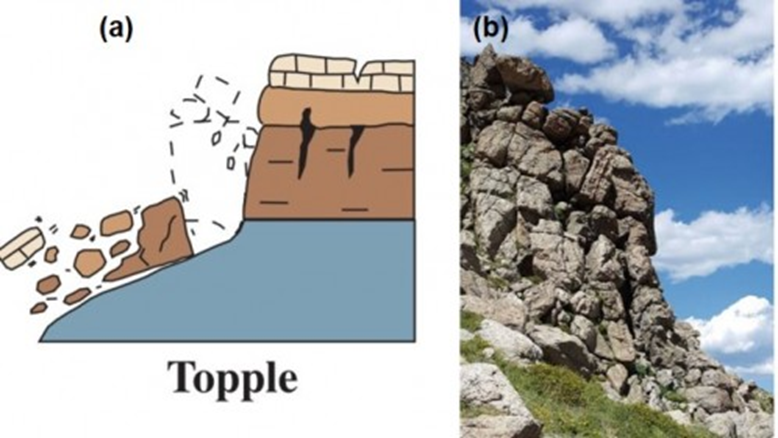
Topples: Topples are failures that resemble falls but involve rotational movement around a point located in a relatively low position. They commonly occur in rocky materials.


Slides: Slides refer to ground movements along a specified surface or zone of weakness. They occur when shear stress overcomes the shear strength along a surface. There are two main types: rotational slides and translational slides.


Lateral Spreads: Lateral spreads are deformational phenomena caused by liquefaction. They occur when saturated soil, usually sands, experiences a loss of strength due to sudden changes in stress conditions.


Flows: Flows can be slow or fast-moving and take different forms. In rocks, slow movements can result in folding or bending. In soils, there are various types, including debris flows, debris avalanches, earthflows, mudflows, and creep.


Understanding Slope Stability:

Slope stability is governed by two key factors: driving forces and resisting forces. Driving forces tend to destabilize slopes, while resisting forces work to counteract these destabilizing effects. Driving forces are influenced by factors such as slope inclination, unit weight of the ground, and slope height. Resisting forces, on the other hand, depend on the shear strength of the soil or rock materials, the presence of discontinuity planes, and any additional stabilizing forces, such as buttresses.

Factor of Safety and Slope Stability Methods:

The Factor of Safety (FoS) is a critical parameter used to assess slope stability. It is defined as the ratio of resisting forces to driving forces. If the FoS is less than 1, the slope is unstable, and landslides are likely to occur. FoS values slightly above 1 indicate a relatively stable slope, but external factors such as earthquakes can temporarily increase driving forces or reduce resisting forces, potentially leading to landsliding. Generally, an FoS higher than 2 indicates a stable slope with a lower risk of instability.

To analyze and mitigate slope stability issues, engineers employ various methods, including empirical approaches, limit equilibrium methods, finite element analysis, finite difference methods, and discrete element analysis. One widely used method is the method of slices, which was introduced by W. Fellenius. This method involves dividing the soil mass above the assumed failure surface into vertical columns, or slices, and ensuring force and moment equilibrium for each slice. The method of slices considers shear strength criteria, typically employing the Mohr-Coulomb criterion, and involves solving a set of equilibrium equations.

Conclusion:

Understanding slope stability is crucial for civil engineers and professionals involved in geotechnical engineering. By comprehending the causes of slope failures, types of landslide movements, and employing effective slope stability analysis methods, engineers can design and construct infrastructure projects that minimize the risks associated with slope instability. By considering factors such as driving forces, resisting forces, and the critical Factor of Safety, engineers can make informed decisions and implement appropriate measures to ensure slope stability and mitigate the potential for landslides.Remember, slope stability analysis should be conducted for both natural and artificial slopes to ensure the safety and longevity of our infrastructure projects. By prioritizing slope stability in engineering practices, we can protect lives, prevent infrastructure damage, and create sustainable environments for future generations.


Labels: ,