Sunday, 24 February 2019

Soil Liquifaction

Soil liquefaction can be defined as the phenomenon by which the strength of the soil is lost either due to dynamic or static loading. Most of the earthquake forces are the major causes of soil liquefaction.
The vibrations of earthquake shockwaves in water-saturated soils trigger the phenomenon.

|                                                       
saturate soil             

Liquefaction occurs in saturated soils, that is, soils in which the space between individual particles is completely filled with water. This water exerts pressure on the soil particles that influence how tightly the particles themselves are pressed together. Prior to an earthquake, the water pressure is relatively low. However, earthquake shaking can cause the water pressure to increase to the point where the soil particles can readily move with respect to each other.


Why it has happened
During an earthquake or other vibration in the ground, the liquid consistency of the ground cannot support objects. Buildings, bridges, trees, and other objects collapse or sink into the soil. In most countries, modern building codes require builders and architects to analyze the viscosity of the soil before developing the land.
  1. Flotation of buried objects, such as pipelines, fuel tanks, and more
  2. Landslides
  3. Lateral spreads, or landslides on gentle slopes
  4. Quicksand
  5. Sand boils, or sand volcano
  6. Sinkholes


How can we prevent soil liquefaction?
Builders can set the footings of the foundation deeper than the layer of unstable soil. Wherever possible, builders try to set the footings onto bedrock. This is especially important for bridges, dams, and other building sites near water. However, this is not always practical or possible.
Technicians insert vibrating probes into the soil at deep levels, and the trembling shakes the loose soil. The compression of the loose soil particles lessens the number of air pockets where water can settle.


Liquefied soil also exerts a higher pressure on retaining walls, which can cause them to tilt or slide. This movement can cause settlement of the retained soil and destruction of structures on the ground surface

Read more »

Labels: , ,

Ingredients used in paint construction


   The essential ingredients of paints are:

Base
Vehicles
Pigment
Drier/ accelerator
Thinner

Base: It is a principal constituent of paint. It also possesses the binding properties of the finely divided material. It is opaque (untransparent) in nature. Commonly used bases for paints are white lead, red lead, zinc oxide, iron oxide, titanium white, aluminum powder and lithophone. A lead paint is suitable for painting of iron and steel works, as it sticks to them well. However it is affected by atmosphere action and hence should not be used as final coat. While zinc forms good base but is costly.
Lithophone, which is a mixture of zinc sulphate and barytes, is cheap. It gives good appearance but is affected by day light. Hence it is used for interior works only.


Vehicles: It helps to mix the various ingredient use in paint. The vehicles are the liquid substances which hold the ingredients of a paint in liquid suspension and allow them to be applied on the surface to be painted. Linseed oil, Tung oil and Nut oil are used as vehicles in paints. Of the above four oils, linseed oil is very commonly used vehicles. Boiling makes the oil thicker and darker. Linseed oil reacts with oxygen and hardens by forming a thin film.

Pigment: Pigments give required colour for paints. They are fine particles and have a reinforcing effect on thin film of the paint. The common pigments for different colours are:
Black- Lamp black, suit and charcoal black
Red-  venedion red, red lead and Indian red
Brown- burned timber, raw and burned sienna
Green- chrome green, copper sulphate
Blue- Prussian blue and ultra marine
Yellow- ochre and chrome yellow

Drier or accelerator:  These are the compounds of metal like lead, manganese, cobalt. The function of a drier is to absorb oxygen from the air and supply it to the vehicle for hardening. The drier should not be added until the paint is about to be used. The excess drier is harmful because it destroys elasticity and causes flaking. It is Used about 8-10%  in the paint.


Labels: , ,

Friday, 22 February 2019

defects in brick

1) OVER-BURNING OF BRICKS
During the production of bricks, we have to burnt bricks to achieve sufficient hardness after moulding clay into a required shape. During heating, if the brick overburnt, then soft molten mass is produced and the brick looses its required shape.

Bricks should be burned at temperatures at which incipient complete and viscous vitrification occur. However, if the bricks are over burnt, a soft molten mass is produced and the bricks loose their shape. Such bricks are not used for construction works.


2) UNDER BURNING OF BRICKS
When bricks are not burnt to cause complete vitrification, the clay is not softened because of insufficient heat and the pores are not closed. This results in higher degree of water absorption and less compressive strength. Such bricks are not recommended for construction works.


3) BLOATING
This defect observed as spongy swollen mass over the surface of burned bricks. This is caused due to the presence of excess carbonaceous matter and sulphur in brick-clay.


4) BLACK CORE
Presence of bituminous matter or carbon in the brick clay is the cause of this defect. When these matters are not completely removed by oxidation, due to improper burning, the brick results in black core.


5) EFFLORESCENCE

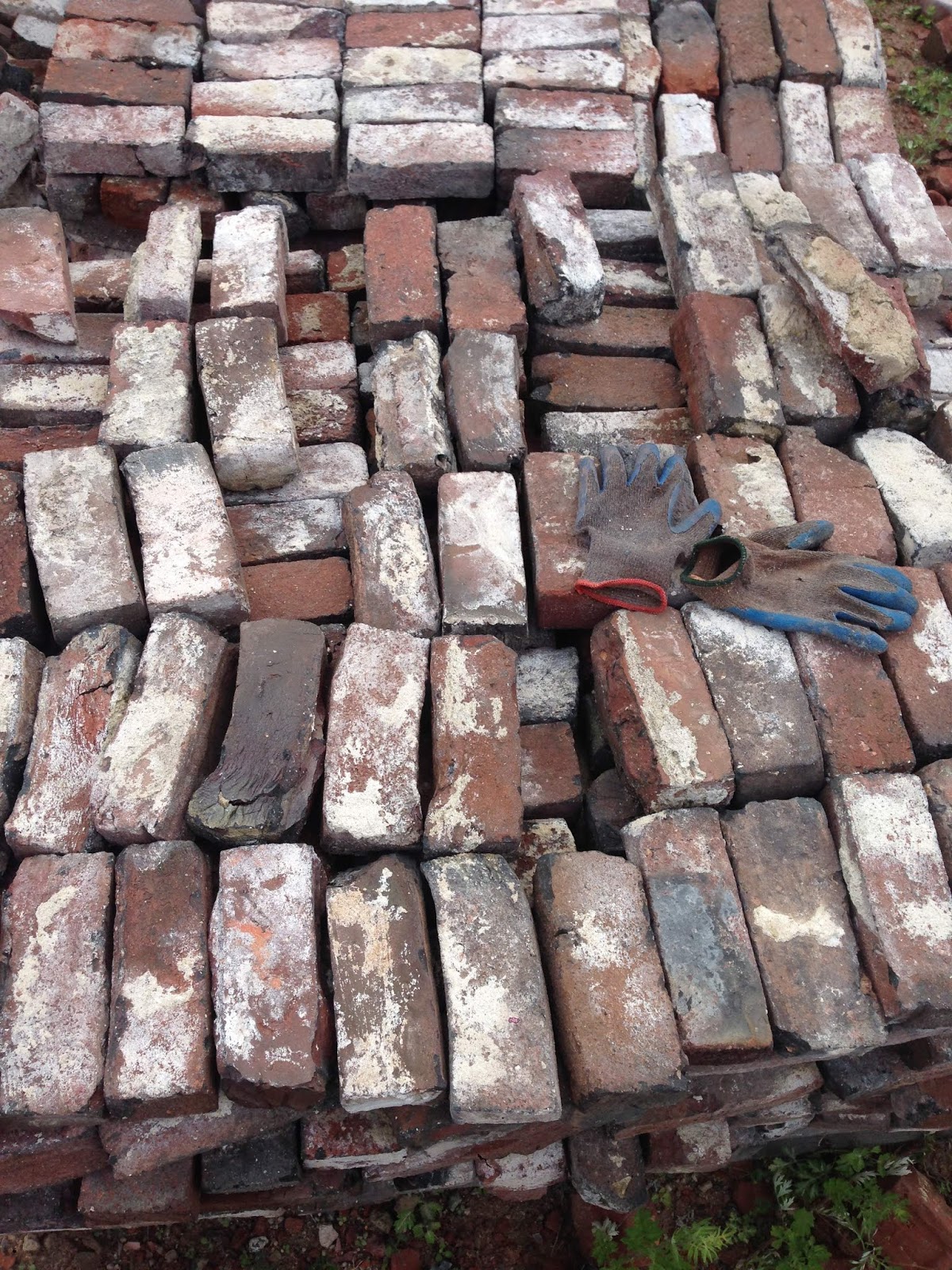
This type of defects in bricks is caused during the absorption of moisture present in the surroundings. If the brick contains alkaline nature(soluable salt). During the contact of moisture with brick, the alkaline substance absorbs moisture. During drying small powder patches will appear on the surface of the brick. Efflorescence will effect in the deterioration of plastering.


6) CHUFFS
The deformation of the shape of bricks caused by the rain water falling on hot bricks is known as chuffs.

7) SPOTS
Iron sulphide, if present in the brick clay, results in dark surface spots on the brick surfaces. Such bricks though not harmful are unsuitable for exposed masonry work.


8) BLISTERS
Broken blisters are generally caused on the surface of sewer pipes and drain tiles due to air imprisoned during their moulding.
9) LAMINATIONS
These are caused by the entrapped air in the voids of clay. Laminations produce thin lamina on the brick faces which weather out on exposure. Such bricks are weak in structure.


10) LIME BLOWING
Disintegration of bricks is the indicator of lime blowing.
If bricks contain lime lump, then lime blowing is expected. The lime absorb water and expand after its exposure to firing. Consequently, lime blowing will take place.
Bricks susceptible to lime blowing can be identified by submerging the brick in water. As a result, the brick fractures and powdery lumps will be exposed.


11) BRICK SPALLING

Irregular portion of the brick break away of fall off.
Heating of water inside brick is the cause of spalling