Design of Barrage | Design capacity of barrage | Weir
As per IS 6966-(Part-1) the discharge of barrage or weir is calculated using below formula:


posted by Azlan Ahmad @ May 29, 2022
0 Comments

Discover valuable insights and expert knowledge for civil engineers at Legend of Civil. Our comprehensive collection of blogs and articles covers a wide range of topics, including structural engineering, construction management, geotechnical engineering, and more. Get access to in-depth discussions, practical tips, and industry trends to stay ahead in the field of civil engineering. Join our community of passionate civil engineers and unlock a wealth of resources.
As per IS 6966-(Part-1) the discharge of barrage or weir is calculated using below formula:
posted by Azlan Ahmad @ May 29, 2022
0 Comments
The weir and barrage failure
may take place due to the following reasons
When water
seeps under the base of the weirs founded on the permeable soils, emerges out
at the D/S end of the impervious floor of the weir, hydraulic gradient or exit
gradient may exceed a certain critical value for the foundation soil, the soil
starts boiling at the exit point.

Boiling of
the soil indicates lifting of the soil against gravity and it happens only when
exist gradient of seeping water is greater than the safe limit for the
foundation soil. The soil gets wash out with percolating water.
This
process of erosion of soil from below the foundation, progressively, works
backward towards the U/S. This process ultimately develops a channel or pipe,
below the foundation of the weir and causes failure of the weir.
Remedies:
.jpg)
Seeping water through
the foundation, exerts uplift pressure, on the floor. The uplift pressure is maximum at the point, just
D/S of the weir wall or crest wall, when water is full up to the top of the
gates and there is no water on the D/S side.

Hence critical
section the floor is just at the D/ S side of the weir’s chest wall. If the thickness of the floor is insufficient, its
weight would be inadequate to resist the uplift pressure. This may ultimately lead to bursting of the floor
and thus failure of the weir may occur.
Actually, once the
floor is burst due to uplift pressure the effective length of seepage is very
much reduced which causes a further increase in the exit gradient and
consequent failure by piping.
Remedies:
Standing
waves of hydraulic jump formed at the D/S of the weir cause suction. This
suction increases the effect of uplift. If floor thickness is inadequate to
sustain the combined effect of uplift and suction, it will fail. Such failures
occurred at Marala weir on the Chenab and Rasul weir.
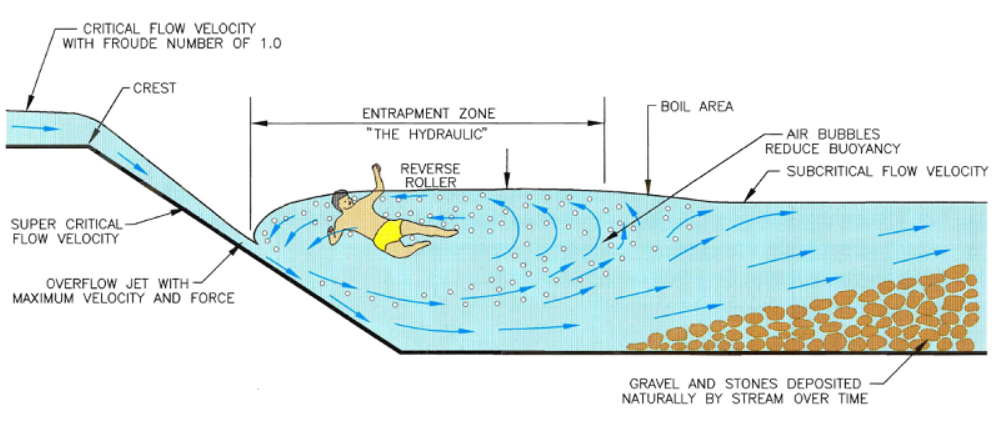
Remedies:
The beds of
alluvial rivers are scoured to considerable depths especially during floods. This
scouring may take place on the U/S side also, but it is most likely on the D/S
side of pucca floors.
If this scour is allowed unchecked, it will form scour holes underneath the pucca floor. These holes may slowly progress towards the main weir and cause its failure.

Remedies:
Labels: Barrage, Dam, failure of barrage
posted by Azlan Ahmad @ May 22, 2022
0 Comments

Subscribe to
Posts [Atom]
